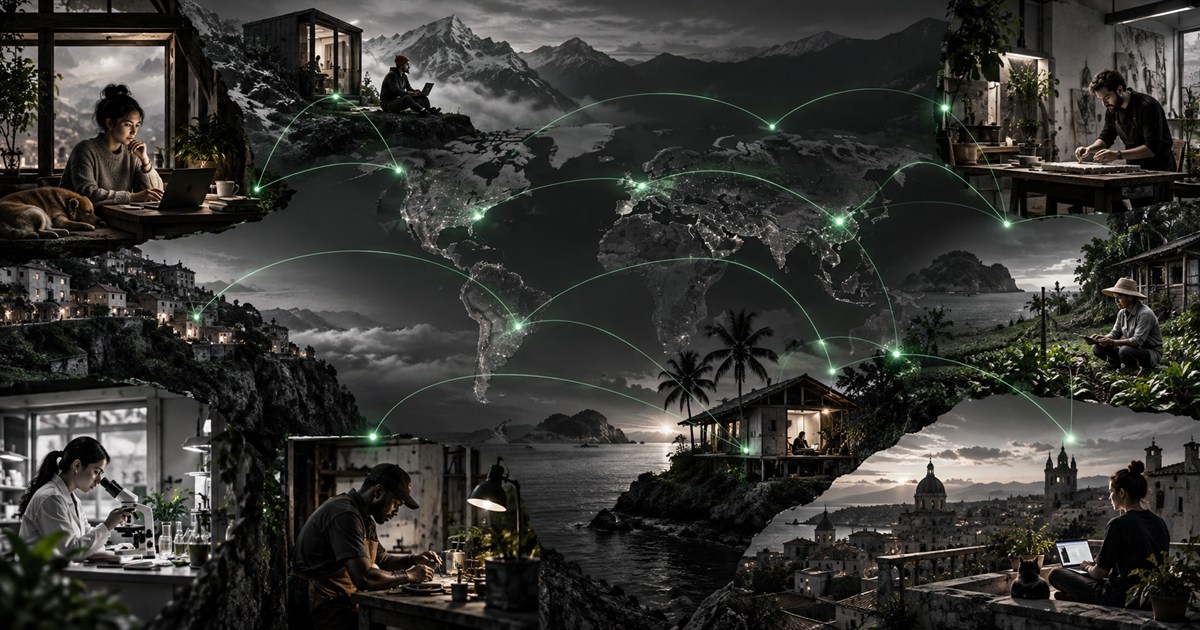
Local First. Network Assisted.
The internet did something magnificent.
It made information extraordinarily difficult to contain.
Anybody could publish.
Anybody could build a server.
Anybody could connect.
No single company owned the web.
Then we spent about thirty years constructing centralized kingdoms on top of it.
Your social graph lives in one kingdom.
Your purchase history in another.
Your professional identity in another.
Your messages somewhere else.
Your artificial intelligence increasingly sits in another.
Each platform provides tremendous value.
But each platform also becomes a center of gravity.
StoinNet starts from a different architecture.
The node
At the center of StoinNet is not the platform.
It is the node.
A node can combine:
Identity.
Memory.
Intelligence.
Permissions.
Ownership.
Governance.
Reputation.
Wallets.
The exact technical architecture will evolve.
The philosophical architecture shouldn’t.
Local First. Network Assisted.
Your private information begins within your boundary.
You publish intentionally.
You grant access explicitly.
Your dragon represents your interests into the broader network.
The network helps you.
But joining the network does not require surrendering yourself to it.
Decentralization isn’t a religion
This doesn’t mean every user needs a server humming in their basement.
I don’t care where every byte physically lives nearly as much as I care about who controls it.
Cloud services can be useful.
Centralized infrastructure can be efficient.
Frontier models may remain enormously expensive.
The important issue is sovereignty.
Can you leave?
Can you revoke?
Can you export?
Can you know what crossed the boundary?
Can one node access another without permission?
Can value generated from your contributions be attributed back to you?
If the answer is no, moving a database onto a blockchain doesn’t magically make the system decentralized in the ways that matter.
An internet with provenance
Now imagine millions of nodes.
One synthetic needs information.
It asks the network.
Other nodes may have useful knowledge.
Some information is public.
Some can be shared anonymously.
Some requires payment.
Some requires explicit permission.
Some never leaves its originating node.
Responses can carry provenance.
Who contributed?
What source supported it?
What transformations occurred?
Which permissions were involved?
What value resulted?
StoinNet becomes not merely a network for moving information.
It becomes infrastructure for ownership, consent, governance, attribution, reputation, and value exchange.
Navier–Stokes showed the problem
A remarkable real-world example arrived almost on cue.
In September 2026, OpenAI announced that an internal multi-agent system had produced a proposed solution to the Navier–Stokes Millennium Prize Problem. OpenAI says the agents sent millions of messages and used enormous compute while working toward the proof.
At the same time, mathematicians Tristan Buckmaster and Levent Alpöge had been working on related mathematics. OpenAI says its researchers and agents did not access their specific work before it became public and says the results differ. But OpenAI also wrote that, while unlikely, it cannot completely rule out that de-identified data derived from the researchers’ use of its products had contributed to model improvement.
I don’t know whether that happened.
Neither does the public.
And that’s exactly why I find the example so interesting.
This is not an accusation against OpenAI.
It’s an architectural problem.
Human knowledge.
Private interaction.
Model improvement.
Synthetic reasoning.
Derived insight.
Academic priority.
Economic value.
Attribution.
These are becoming intertwined faster than our existing ownership systems can describe them.
What if attribution were native?
Imagine a mature StoinNet version of a similar situation.
A mathematician’s dragon develops an insight.
The mathematician chooses whether it remains private.
Perhaps she later authorizes a particular abstraction to be shared.
That contribution receives a provenance receipt.
Another node builds upon it.
The derivation remains connected.
A synthetic system discovers a further result.
The graph continues.
Eventually, something valuable emerges.
We don’t have to reconstruct the lineage after the fact.
The lineage was part of the system from the beginning.
That does not magically solve intellectual-property law or every dispute about originality.
Nothing does.
But it’s a much better starting point.
An internet of owners
This is where the previous essays converge.
Stoinism provides the economic philosophy.
Stoin provides a way to represent value and rights.
DAOs provide governance.
Personal dragons provide intelligence.
Nodes provide sovereignty.
StoinNet connects them.
Humans and synthetics collaborate.
Knowledge moves with permission.
Contributions carry attribution.
Reputation accumulates.
Economic value can flow back toward the people and systems that produced it.
You don’t merely use the network.
You participate in it.
You contribute to it.
You can own parts of what you create through it.
The original internet created an internet of information.
I want to explore whether the next one can become an:
Internet of Owners.